

College & Career Planning for First-Generation Students: A Roadmap Built on Real Experience
At KDA Foundation, we work every day with students who are charting entirely new territory for their families. They are the first to apply to college, the first to navigate financial aid, the first to write a resume, and often the first to ask: “How does any of this actually work?” College and career planning for first-generation students begins with that question, and our job is to make sure every student who asks it gets a real, practical answer backed by people who genuinely care.
That question does not signal a gap in intelligence. It signals a gap in access. First-generation students are not behind because they lack ability. They are behind because no one in their immediate circle has mapped this road before, and the systems designed to guide them were never built with their specific reality in mind.
What these students need is not a brochure or a one-time workshop. They need daily, structured support from mentors who understand the real weight of being a pioneer inside your own family. They need a step-by-step system that builds momentum over time, not a checklist handed to them in October of senior year with no follow-through.
That is exactly what we built. At KDA Foundation, our programs meet first-generation students where they are, give them the tools they need to move forward, and stay with them every step of the way.
Why First-Generation Students Face a Different Set of Obstacles
The challenges first-generation college students face are not simply academic. Most of the friction happens long before a student ever sits in a college classroom. It lives in the process itself: requesting transcripts, decoding a CSS Profile, comparing financial aid award letters, and understanding why a campus visit actually matters. When students in our programs at KDA Foundation tell us they feel overwhelmed, it is rarely because they lack drive. It is because they are carrying the emotional weight of being a pioneer while trying to decode systems that were never built to be self-explanatory.
According to the National Center for Education Statistics, first-generation college students are significantly less likely to seek help from academic advisors, more likely to work part-time jobs that cut into study time, and more likely to experience impostor syndrome, the persistent feeling that they simply do not belong in a college environment. These are not personal failures. They are predictable outcomes of navigating an unfamiliar system without a guide.
College and career planning for first-generation students must account for all of these layers. At KDA Foundation, we address them directly through structured mentorship, daily accountability challenges, and real-world experiences that replace self-doubt with confidence built through action.
The Foundation We Build First: Life Skills and Self-Awareness
Before any student can build a meaningful college list or draft a real career plan, they need something that no application checklist can provide: a clear understanding of who they are. We see this play out consistently inside our programs at KDA Foundation. A student who knows how they learn, what genuinely energizes them, and where their strengths live makes far better decisions about majors, schools, and career paths than one who is simply chasing a prestigious name or a salary number.
According to the American Psychological Association, self-awareness and executive function skills, including planning, focus, follow-through, and self-advocacy, are among the strongest predictors of long-term academic success. Inside our KDA Foundation program, students work through daily bite-sized challenges designed specifically to build these skills over time, not in a single workshop but through consistent, supported practice that compounds week after week.
We also offer a five-measure career assessment with a 60 to 90-minute debrief for juniors and above. When college and career planning for first-generation students is rooted in self-awareness, every decision that follows becomes clearer, more confident, and more intentional.
Understanding the College Landscape from Coral Springs to the Country
Here in Coral Springs, Florida, we work with students and families who enter the college process from very different starting points. Some are academically strong but financially uncertain. Others have real potential but no roadmap for communicating their story to an admissions committee. Broward County is one of the most diverse counties in Florida, and that diversity shapes everything about how we approach our work at KDA Foundation. Understanding the college landscape means understanding people, and the realities first-generation students face vary by city, background, and circumstance. Here is what we see on the ground every day.
Academically Strong but Financially Uncertain
Many students we work with in Coral Springs carry strong grades into the college process, but have no clear picture of how to pay for it. Financial aid forms, expected family contribution calculations, and scholarship deadlines can feel like a second full-time job. At KDA Foundation, we help students navigate these systems step by step, identifying grant opportunities, understanding award letters, and building a financial plan that makes higher education a realistic goal rather than an overwhelming question mark.
Student-Athletes Who Do Not Know the Recruiting Rules
A significant portion of our students come to us with genuine athletic ability and very little understanding of how college recruiting actually works. They assume coaches will find them. They do not realize that grades, character, and proactive outreach carry as much weight as game tape. Our STEALTH Rating system and Playing the Recruiting Game curriculum give these students a structured, 26-week plan for presenting themselves professionally to college programs across the country.
First-Generation Families Without an Inside Network
For families where no one has been through the college process before, the absence of an informal knowledge network is one of the biggest barriers to success. There is no older sibling to call, no parent who remembers which deadlines matter most, and no cousin who has compared financial aid letters. Our Dreamer Box fills part of that gap by putting career exploration materials, wellness resources, and practical project tools directly into students’ hands at home, so learning does not stop when the school day ends.
Students Who Earned Their Way to Top Universities
The results our students achieve are not accidental. Graduates of KDA Foundation programs have gone on to attend the University of Michigan, the University of Southern California, Temple University, Marshall University, Indiana State University, and Lawrence University of Wisconsin, among others. These outcomes reflect consistent mentorship, smart planning, and students who committed to the daily work our programs require. College and career planning for first-generation students, done right, produces exactly this kind of outcome.
The Recruiting Game: A Pathway Many First-Gen Students Never Knew Existed
One of our signature programs, Playing the Recruiting Game, is a 26-week step-by-step curriculum specifically designed for student-athletes who want to play at the college level. This program fills a massive information gap that disproportionately affects first-generation families.
Many students assume that coaches will find them. Many parents assume that talent is enough. The reality of college recruiting is far more complex, and students who do not understand that process are consistently outpaced by peers whose families have been through it before.
Our STEALTH Rating system (Students Taking Education Athletics Life To Heart) gives student-athletes an honest, objective snapshot of where they stand academically, athletically, and in terms of character and work ethic. This rating becomes a communication tool that students use to present themselves professionally to college programs.
One of our students, Jason Powell from Piper High School in Sunrise, Florida, reflected on how his experience with Coach Stoutt and KDA Foundation changed his perspective. He shared that he was given a second chance, not just to play sports again, but most importantly to pursue an education. He learned that academics, grades, and GPA are what open real doors, and that he had the ability to become a contributor to the next generation.
That is precisely what college and career planning for first-generation students should do. It should not just open doors. It should help students understand why those doors matter.
Building a Career Path, Not Just Landing a Job
Too often, career planning gets reduced to “pick a major” and “update your resume.” We think about it differently. A career is not a destination. It is a direction, and the work of college and career planning for first-generation students is to help young people find a direction that aligns with who they are, not just what the market says they should be.
Inside our program tracks, students can explore eight areas of focus: Education and School Life, Career Readiness, Social Life, Emotional Well-Being, Family Relationships, Life Skills, Hobbies and Passions, and Purpose and Goals. Students typically start with one or two tracks that feel most urgent and add others as they grow.
The Career Readiness track gives students concrete tools: resume artifacts, interview practice, and an early network of mentors who are active professionals in their fields. We partner with businesses throughout South Florida and beyond that offer internships, job shadows, and workshops that bring the world of work directly into contact with our students.
When a business becomes what we call a Dream Builder, they are not just making a donation. They are opening their organization to young people who deserve real exposure to real careers. For first-generation students, this kind of access is often the deciding factor in whether a career path feels achievable or abstract.
How Families and Schools Play a Vital Role
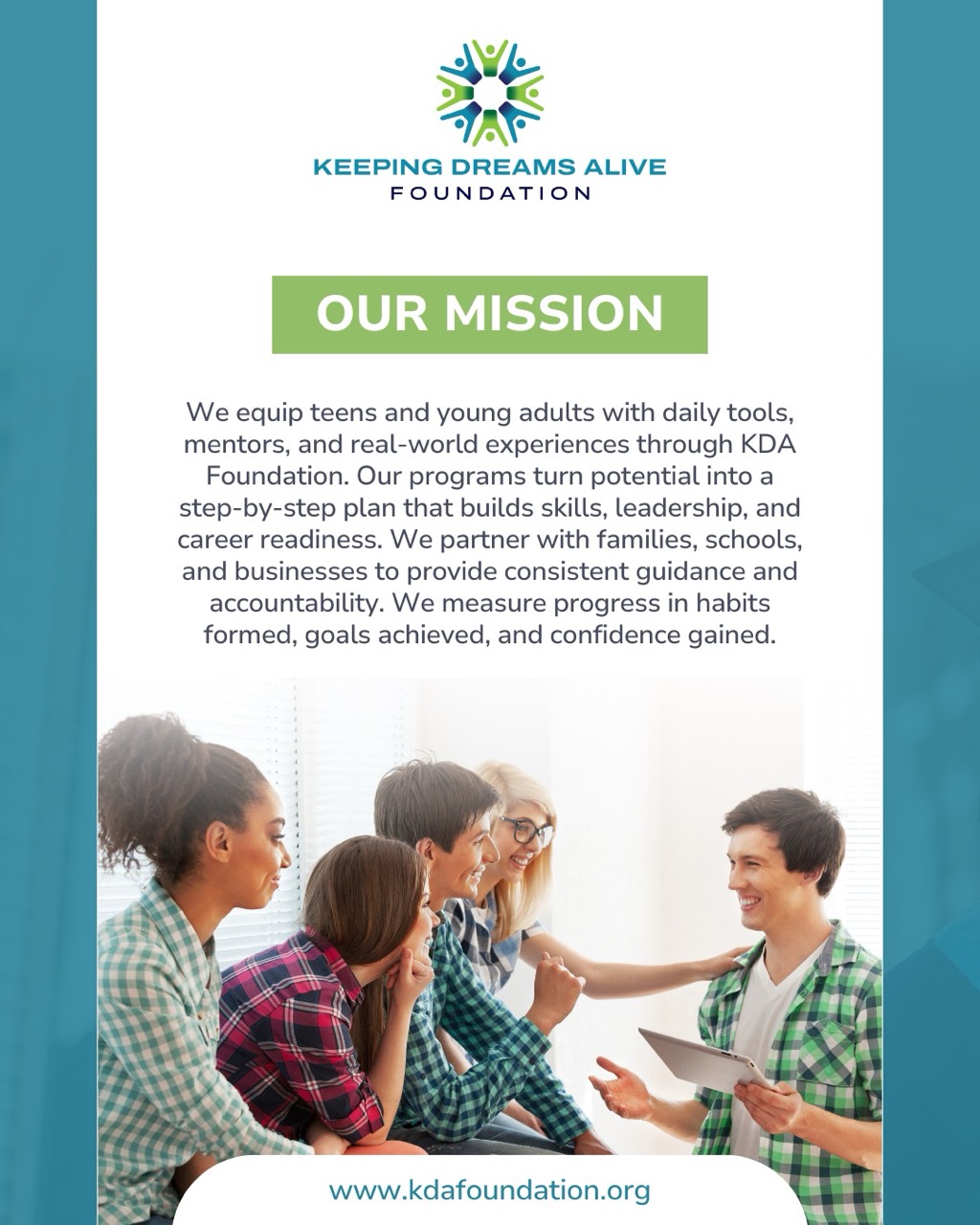
Over more than two decades of work, we have learned one truth that shapes everything we do at KDA Foundation: a student’s success is rarely determined by the student alone. The adults surrounding them, including parents, guardians, teachers, and coaches, play an enormous role in building or breaking the momentum a student works hard to create. College and career planning for first-generation students works best when the whole support system moves together. Here is how we bring everyone into the process.
- For Parents and Guardians: We bring parents directly into the college and career planning process rather than simply sending updates home. Through conversation guides, shared goal plans, and structured check-in rhythms, we give families the language and confidence to support their student through every step, including the difficult ones.
- For Teachers and School Counselors: Our school-based integration options are designed to fit inside existing bell schedules and after-school programs without adding friction for educators. We provide measurable checkpoints and clear outcomes so teachers and counselors can see exactly how students are progressing and where additional support is needed.
- For Communities Across Florida and Beyond: We currently serve students across Broward and Dade Counties and are actively expanding. Our Coral Springs, FL waiting list is open now, our Jacksonville, FL chapter launched in early 2026, and more cities are scheduled to follow as our KDA Centers continue to grow nationwide.
Real Outcomes: What Progress Looks Like in Our Community
Choosing the right support system for a first-generation student is one of the most important decisions a family can make, and we do not take that trust lightly. KDA Foundation has been doing this work since 2001, built by people who lived the experience themselves. Our founders, mentors, and staff include former NFL players, university scholars, educators, and community leaders who understand what it takes to navigate the path from potential to opportunity.
Our programs are not theoretical. They are built around daily action, real mentorship, and measurable outcomes that families can see week after week. From our five-measure career assessments to our 26-week recruiting curriculum and the hands-on Dreamer Box, every tool we offer exists because a student somewhere needed it, and we built it for them.
We are also locally rooted and nationally minded. Based in Coral Springs, Florida, we serve students throughout Broward and Dade Counties while expanding to cities across the country. When you choose KDA Foundation, you are choosing a team that stays with your student from the first goal to the final acceptance letter.
Frequently Asked Questions (FAQs) College & Career Planning for First-Generation Students
- What exactly does “first-generation student” mean?
A first-generation student is someone whose parents did not complete a four-year college degree, meaning they navigate applications, financial aid, and campus life without guidance from college-educated family members. - When should a first-generation student start college and career planning?
We recommend starting in ninth grade. College and career planning for first-generation students is most effective when it begins early, well before senior year deadlines and application pressure arrive. - How does KDA Foundation specifically help first-generation students?
We provide daily structured guidance, career assessments, mentorship, the Dreamer Box, and athlete-specific support through our STEALTH Rating and Playing the Recruiting Game curriculum, connecting students to real opportunities. - What financial aid resources should first-generation students know about?
Students should know the FAFSA, state grants, institutional need-based aid, and first-generation scholarships. Our mentors help students read and compare financial aid award letters, one of the most confusing steps in the process. - Is college the only path worth pursuing?
Not at all. College and career planning for first-generation students includes trade schools, apprenticeships, entrepreneurship, and military pathways. We help every student find the direction that fits their strengths and goals. - How does mentorship help first-generation students specifically?
Mentors close the information gap by answering questions students do not yet know how to ask. They also encourage self-doubt, which is common when charting territory your community has not explored before. - What is the STEALTH Rating, and how does it help student-athletes?
The STEALTH Rating evaluates academics, character, work ethic, and athletic readiness. It gives student-athletes and families a clear, objective picture of where they stand and helps them communicate professionally with college coaches.
Start Building the Future With KDA Foundation
Phone: (954) 775-8255
Email: [email protected]
Address: Coral Springs, Florida
Every student deserves access to guidance, opportunity, and a clear path forward. KDA Foundation helps first-generation students develop the confidence, skills, and support systems needed to pursue meaningful goals. Through mentorship, career readiness, life skills development, and family engagement, we help Dreamers move forward with purpose. Contact us today and take the first step toward a brighter future.